
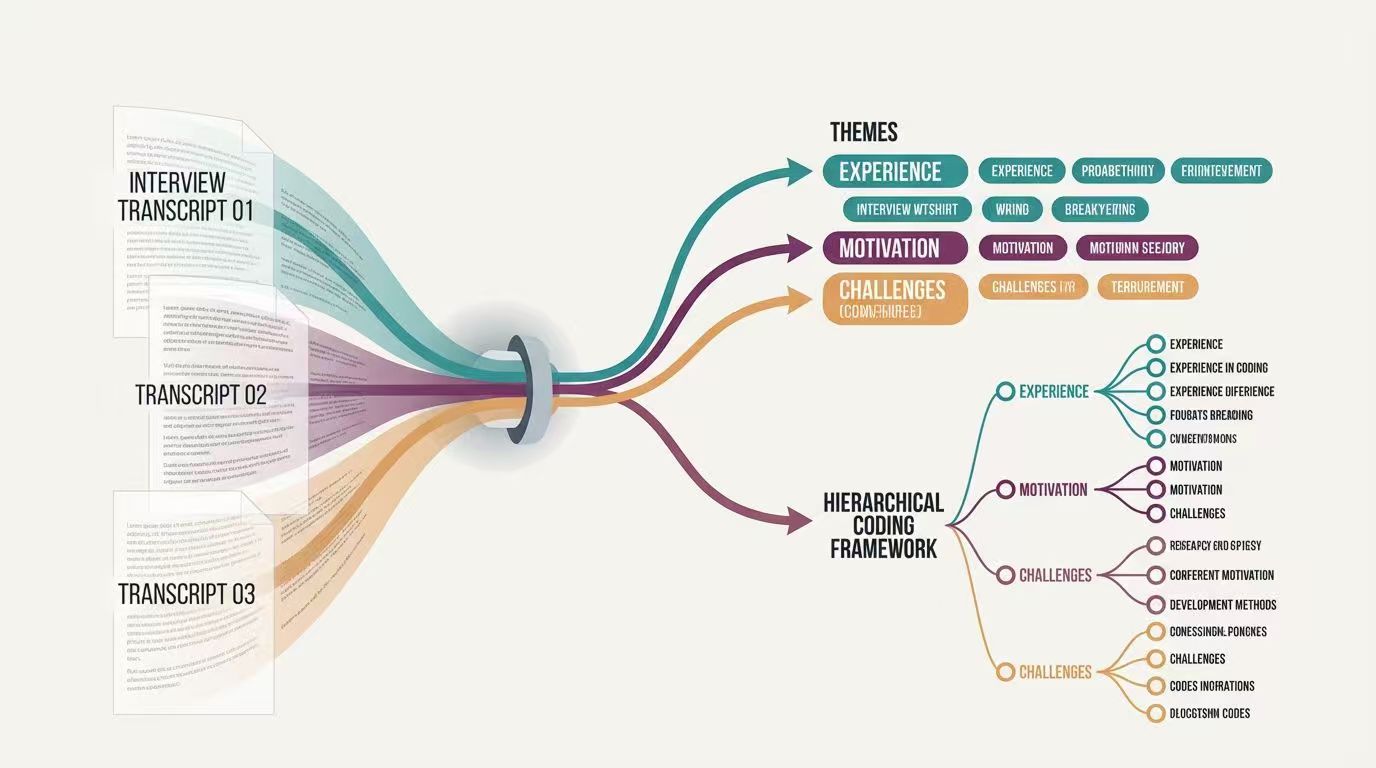
The Qualitative Research Bottleneck
Qualitative research generates rich, nuanced data—but analyzing it is notoriously labor-intensive. A typical interview study involves transcribing hours of audio, reading and re-reading transcripts, developing coding frameworks, and systematically applying codes across hundreds of pages [1].
For a 30-interview study, manual coding can take 200+ hours. Researchers face an impossible trade-off: depth versus scale. Large qualitative datasets often go underutilized simply because thorough analysis exceeds available resources [2].
QualCode: Human Expertise, Computational Scale
QualCode transforms qualitative data analysis by learning from researcher expertise and applying it consistently at scale. The system doesn't replace human judgment—it amplifies it.
Phase 1: Codebook Extraction
The process begins with the researcher coding a small subset of transcripts (5-10%) using their preferred methodology—whether grounded theory, thematic analysis, or framework analysis [3].
QualCode observes these coding decisions and extracts:
- Code definitions: What each code means conceptually
- Inclusion/exclusion criteria: Boundary conditions for code application
- Hierarchical relationships: How codes nest into themes and categories
- Exemplar passages: Prototypical examples of each code
The result is a machine-readable codebook that captures the researcher's interpretive framework.
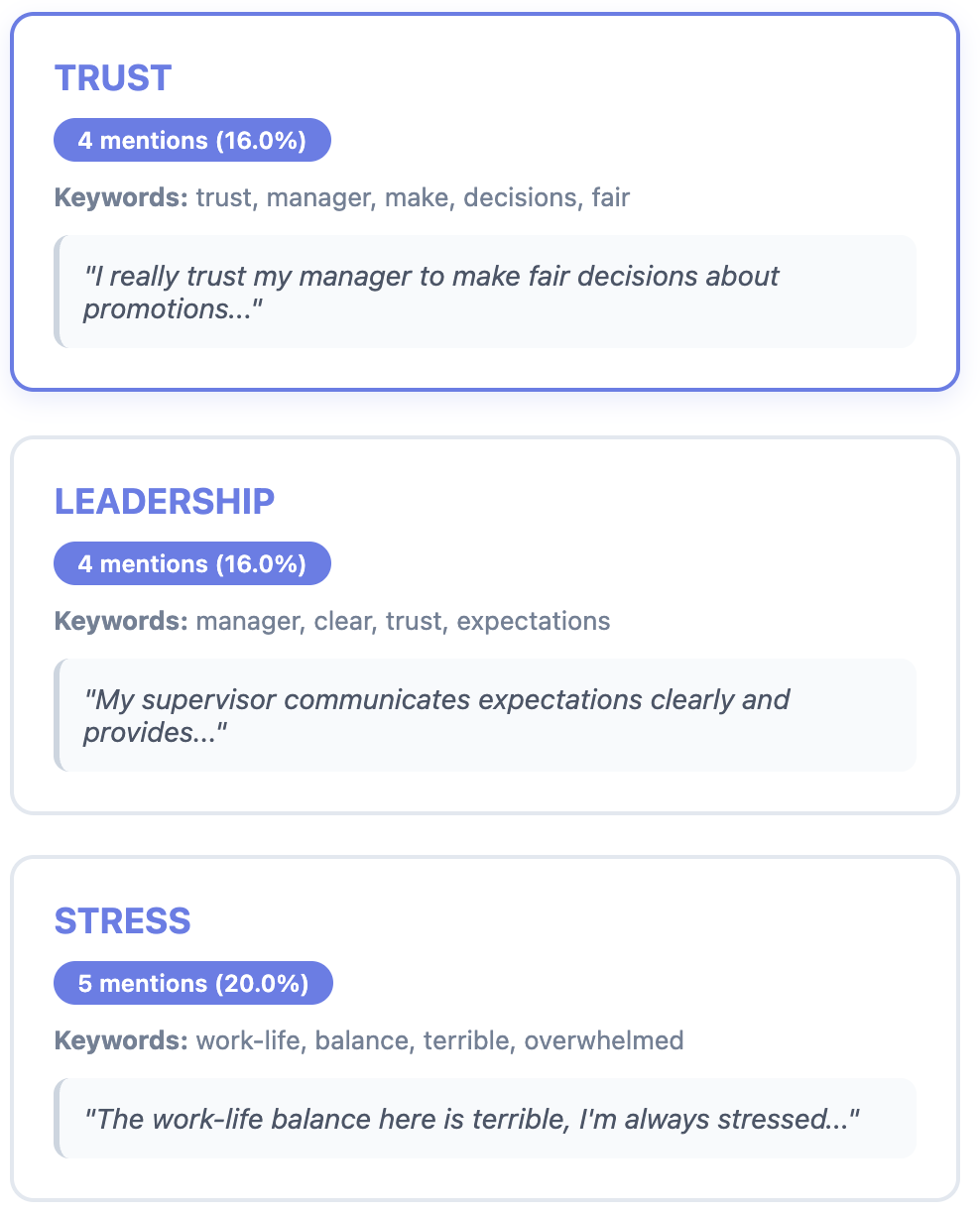 Figure 1: Phase 1 extracts code definitions, hierarchical relationships, and exemplar passages from researcher-coded transcripts.
Phase 2: Systematic Coding
With the codebook established, QualCode applies codes across the remaining transcripts—consistently and transparently.
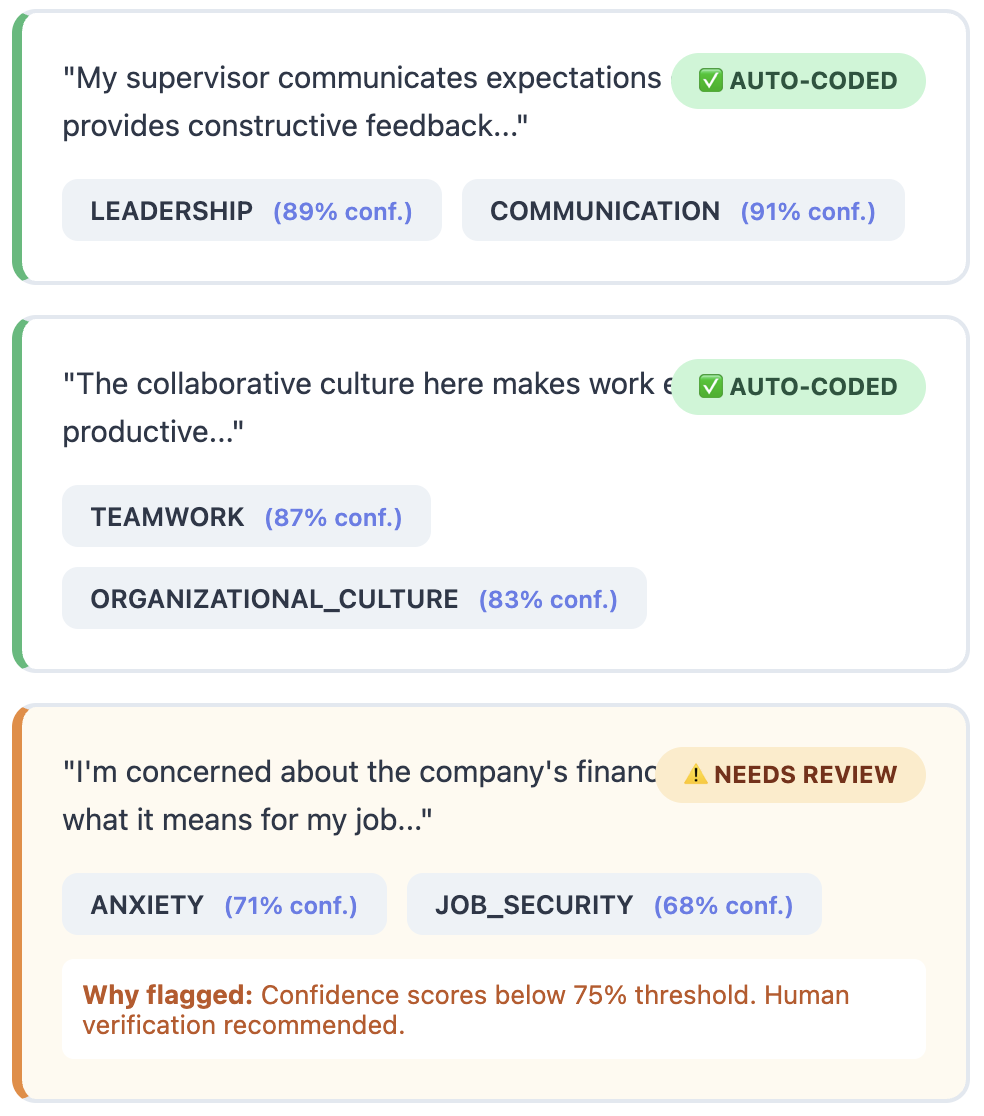 Figure 2: QualCode's coding interface shows auto-coded segments with confidence scores. High-confidence codes (green) are auto-approved; lower-confidence segments (orange) are flagged for human review.
Key features:
- Confidence scoring: Each code assignment includes a confidence percentage based on semantic similarity to training examples
- Auto-approval thresholds: Codes above 75% confidence are auto-approved; below-threshold segments are flagged for review
- Transparent reasoning: The system explains why each code was applied, enabling researcher verification
- Iterative refinement: Researcher corrections feed back into the model, improving accuracy over time
Maintaining Methodological Rigor
Qualitative research validity depends on systematic, reflexive analysis [4]. QualCode preserves rigor through:
Audit trails: Every coding decision is logged with timestamp, confidence score, and rationale
Inter-rater reliability: Compare AI coding against human coders to establish agreement metrics
Negative case analysis: The system flags passages that contradict emerging themes
Member checking ready: Export coded segments for participant validation
From Codes to Insights
Beyond coding, QualCode supports higher-order analysis:
- Theme development: Visualize code co-occurrence patterns to identify emergent themes
- Cross-case comparison: Compare coding distributions across participant subgroups
- Saturation tracking: Monitor when new codes stop emerging to assess theoretical saturation
- Quote extraction: Retrieve exemplar quotes for each theme for manuscript preparation
Real-World Impact
Before QualCode: A 50-interview organizational culture study requires 3-4 months of full-time coding by a trained researcher.
With QualCode: Initial codebook development (2 weeks) + AI-assisted coding with human review (2 weeks) = 75% time reduction while maintaining analytical depth.
Applications
Academic Research: Scale qualitative studies without sacrificing rigor
UX Research: Analyze hundreds of user interviews systematically
Market Research: Extract themes from focus groups and customer feedback
Policy Research: Code public consultation responses and stakeholder interviews
Healthcare: Analyze patient narratives and clinical interviews [5]
The Future of Qualitative Research
The tension between depth and scale has long constrained qualitative inquiry. QualCode resolves this tension—not by automating interpretation, but by handling the mechanical aspects of coding so researchers can focus on meaning-making.
Qualitative research remains fundamentally human. QualCode simply ensures that human insight can reach its full analytical potential.
References
[1] Braun V, Clarke V. Using thematic analysis in psychology. Qualitative Research in Psychology. 2006;3(2):77-101.
[2] Guest G, MacQueen KM, Namey EE. Applied Thematic Analysis. SAGE Publications; 2012.
[3] Charmaz K. Constructing Grounded Theory. 2nd ed. SAGE Publications; 2014.
[4] Lincoln YS, Guba EG. Naturalistic Inquiry. SAGE Publications; 1985.
[5] Pope C, Ziebland S, Mays N. Qualitative research in health care: Analysing qualitative data. BMJ. 2000;320(7227):114-116.